
Two different problems wear the same symptom
Every blocked drain looks the same from the sink. Underneath, there are two completely different situations, and telling them apart is most of the value in calling a plumber rather than buying a bottle of something.
Something is in the pipe. Hair and soap in a bathroom trap, grease and food in a kitchen line, wipes in a toilet. The pipe is fine. Remove the obstruction and the drain works normally for years.
The pipe itself is the problem. Scale narrowing the bore, roots at a joint, a section that has sagged and now holds standing water, or iron that has corroded through. Clearing it produces a few good weeks, then the same blockage in the same place.
The tell is repetition. One clog is an event. The third clog in the same line is a diagnosis you have not had yet.
What we find under Newark houses
Drain material in this area tracks closely with when the house was built, and that determines what goes wrong.
| Built | Typical drain material | How it fails |
|---|---|---|
| Pre-1950 | Cast iron inside, clay lateral outside | Internal scaling; root intrusion at clay joints |
| 1950s–1970s | Cast iron throughout | Scale, then corrosion through the pipe bottom |
| 1970s–1980s | Cast iron or early plastics | Mixed; joint failure at transitions |
| 1990s onward | PVC or ABS | Rarely the pipe. Usually grease, wipes or a belly from poor bedding |
The practical consequence: a recurring kitchen clog in a 1930s house near Main Street and a recurring kitchen clog in a 2003 Bear townhome are not the same job. The first is probably scaled iron. The second is probably grease, or a section of pipe that was never properly supported. Same symptom, different fix, very different price.
How we actually clear a line
- Locate the right access point. Working through a proper cleanout rather than pulling a toilet or dismantling a trap is faster and cheaper. Most Newark basements have one; in some older houses it has been drywalled over, which is worth knowing before we arrive.
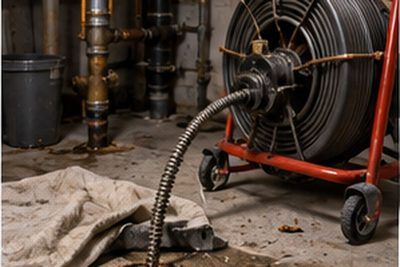
- Cable first, for most blockages. A drum machine with the correct head for the pipe size and the suspected obstruction. Cutting heads for roots, retrieval heads for objects.
- Jet when the pipe wall is the problem. Grease, heavy scale and root regrowth all need the pipe surface restored, not punctured.
- Camera when it has happened before. If this is a repeat, we look. Otherwise we are just selling you the same visit again in three months.
- Run it properly before we leave. Full flow, multiple fixtures at once, watching for the line backing up under real load rather than a trickle.
Where the DIY route goes wrong
Some drain work is genuinely worth doing yourself. Pulling and cleaning a sink P-trap is a fifteen-minute job with a bucket and a wrench, and if a single bathroom sink is slow that is very likely all it needs.
A drain that smells but drains perfectly well is a different problem again, and usually a free one — most of the time it is a trap that has simply dried out. Why your drains smell works through the five causes and how to tell them apart before anyone charges you for anything.
Three things reliably go badly:
- Chemicals on old iron. Caustic cleaners sit on top of the blockage generating heat against pipe that is already thin. They rarely clear grease, roots or scale, and they make the standing water hazardous.
- Rented cable machines in inexperienced hands. A cable that binds in a cast iron line can whip, injure you, or snap and leave the head stuck in the pipe. Retrieving it costs more than the original clearing.
- Treating a main line backup as a fixture problem. If more than one fixture is affected, or a toilet gurgles when the washing machine drains, the blockage is downstream of everything and plunging a sink will not reach it. That is a sewer line situation.
What drives the price
Drain clearing in Newark generally runs $150 to $400 for a single fixture and $300 to $800 for a main line, with hydro jetting at $500 to $1,200. Four things move you within those bands:
- Access. An open basement cleanout is the cheapest scenario. Pulling a toilet, or opening a wall to reach a buried cleanout, is not.
- Length and depth of the run. A short kitchen branch versus eighty feet of lateral out to the street.
- What is in there. Roots need cutting and will regrow. Grease needs jetting. A dropped object needs retrieval rather than pushing.
- Whether the pipe survives. Sometimes clearing a badly corroded cast iron line reveals that the bottom has already rotted out. We would rather find that with a camera first than with a cable.
Full ranges are on our pricing page. We do this work throughout Newark and New Castle County.
Drain Cleaning in Newark — common questions
A drain that clogs repeatedly in the same place is almost never about what you are putting down it. It is the pipe. In older Newark homes that usually means cast iron that has scaled internally — corrosion builds a rough, ridged layer on the pipe wall that catches everything passing over it. Clear it and the surface is still rough, so it catches again.
Hydro jetting scours that layer back to the pipe wall and buys years rather than weeks. If the iron has corroded through to flaking or the bottom of the pipe has rotted out, no cleaning fixes it and the section needs replacing.
No, and they are particularly bad in Newark's older housing stock. Caustic drain cleaners generate heat while they sit, and sitting is exactly what they do above a blockage. On old cast iron that is already thin they accelerate corrosion; on PVC they can soften a joint.
They also rarely work on the blockages people buy them for — grease, roots and scale all shrug them off. The practical result is a drain that is still blocked and now full of caustic liquid that a plumber has to work in. If you have already used one, say so when you call.
Hydro jetting pushes water through a specialised nozzle at very high pressure, cutting grease, scale and roots off the pipe wall and flushing the debris out. A cable punches a hole through a blockage; jetting restores the full diameter of the pipe.
You need it when clearing the line keeps buying you only a few months, when the line carries heavy grease, or when a camera shows scale narrowing the bore. You do not need it for a one-off hairball in a shower trap. We will not sell it to you for that.
For a first-time clog in one fixture, no. For a main line that has backed up more than once, yes — guessing is more expensive than looking. A camera turns a theory into a diagnosis: roots at a joint, a bellied section holding water, scale, or a collapse.
It is also worth doing before you buy any Newark home built before about 1970. A sewer lateral replacement is a five-figure job, and it is far better discovered during negotiation than six months after closing.
What to Expect
How a service call actually goes
No mystery and no vague promise to take a look. Here is the sequence from the moment you dial.
-
You call and describe the problem
A person picks up and asks practical questions — where the water is, whether it is still running, whether you have found the shutoff. If it is an emergency, we walk you through isolating it before we are anywhere near your street.
-
We give you an arrival window
A real window, not sometime today. You get a call before we head over. If the schedule slips, you hear it from us instead of wondering.
-
Diagnosis first, price second, work third
We find the actual cause before quoting. You get the price for the repair in front of you, and what it covers, before any work starts. If the honest answer is that a repair will not hold and you need a replacement, we say so and explain why.
-
We finish, test, and clean up
The repair gets tested under real conditions before we pack up — pressure restored, drains run, no weeping joints. Drop cloths down, debris out, and a plain-language explanation of what failed and what to watch for.
That sequence is the whole of our method, and how we work and price jobs explains the reasoning behind it — including the jobs we will talk you out of.