
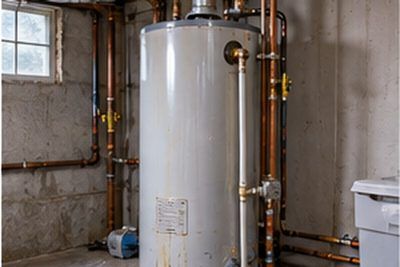
Start with the symptom, not the sales pitch
Water heaters fail in a small number of recognisable ways, and each points at a different component. Knowing which one you have is the difference between a $180 part and a $2,400 replacement — and it is why we diagnose before we quote.
| Symptom | Usual cause | Typically |
|---|---|---|
| No hot water, gas unit | Thermocouple, pilot assembly or gas valve | Repairable |
| No hot water, electric unit | Failed element or thermostat; tripped high-limit | Repairable |
| Runs out fast | Sediment reducing usable volume, or a dip tube | Often recoverable |
| Rumbling or popping | Sediment layer boiling beneath the water | Flush, then reassess |
| Rusty hot water | Anode consumed, tank lining corroding | Late stage |
| Water pooling under the tank | Tank body has perforated | Replace — not repairable |
| Leak at top fittings | Connection, valve or relief valve | Usually repairable |
That last distinction matters more than any other on this page. A leak from the tank body cannot be repaired — the steel has corroded through from the inside and no patch, weld or sealant is a legitimate fix. A leak from a fitting on top is frequently a modest repair. Anyone who offers to repair a leaking tank body is either mistaken or hoping you are.
The anode rod, and why nobody mentions it
Inside every tank water heater is a sacrificial anode rod — a length of magnesium or aluminium whose entire job is to corrode so the tank does not. Electrochemistry attacks the more reactive metal first. Once the anode is consumed, the tank lining becomes the next target.
Replacing an anode costs a fraction of replacing a water heater and can add years of life. It is almost never mentioned, for the straightforward reason that there is far more money in the replacement. We will check yours and tell you where it stands.
Newark water, and what it means for your tank
Most of Newark is supplied by the City of Newark Water Department from the Newark Reservoir, at moderate hardness. That is genuinely good news for water heaters: you should not see the aggressive sediment failures that shorten tank life in hard-water regions, and an aggressively sold water softener is often solving a problem you do not have.
It changes north and west of town. Properties around Hockessin, Pike Creek and the rural edges of the county are frequently on private wells, where hardness and mineral content can be substantially higher and entirely unregulated. On a well, sediment builds faster, annual flushing stops being optional, and treatment may genuinely be worthwhile — see our page on water treatment and well systems.
If you want to know what is actually in your city supply, the City of Newark publishes an annual water quality report. We would rather you read the real numbers than take anyone's word for it, including ours.
Sizing, when it is time to replace
The common failure in replacement is fitting whatever was there before. That is fine if the old unit worked, and a mistake if you were running out of hot water.
- 40 gallon: one or two people, one bathroom.
- 50 gallon: the standard family choice, two to three bathrooms.
- 75 gallon or tankless: larger households, or where a soaking tub and a shower compete.
If tankless is on the table, the decision is made by your house rather than by the appliance — tank or tankless in an older Newark home works through the four things that settle it, starting with the winter inlet temperature that every headline flow rate quietly assumes away.
Recovery rate matters as much as capacity. A gas unit reheats considerably faster than electric, so a 40-gallon gas heater can outperform a 50-gallon electric one for a household with concentrated morning demand. If everyone in your house showers between seven and eight, that is the number to optimise for.
What the visit looks like
For a repair: we test the actual components — thermocouple continuity, element resistance, thermostat calibration, gas pressure — rather than replacing parts until the symptom goes away. You get the fault, the price, and an honest view on whether the rest of the unit justifies fixing it.
For a replacement: old unit drained and removed, new unit set and connected, new flex connectors and shutoff, relief valve and discharge piped correctly, venting checked on gas units, and the whole thing filled, purged and tested before we leave. The permit is pulled and the state inspection scheduled. The old heater goes with us.
Typical Newark ranges: repairs $150 to $600, tank replacement $1,500 to $3,000, tankless installation $3,500 to $7,000. Full detail on the pricing page. If your hot water problem turns out to be pressure rather than temperature, corroded galvanized supply is the more likely culprit.
Water Heater Repair & Replacement in Newark — common questions
A conventional tank water heater typically lasts 8 to 12 years, and a tankless unit 15 to 20 with annual servicing. Newark is on City of Newark reservoir water at moderate hardness, which is kinder to tanks than genuinely hard-water regions — you are unlikely to see the four-year sediment failures common in parts of the Midwest.
The exception is well-supplied properties toward Hockessin and Pike Creek, where untreated water can be considerably harder and sediment builds faster. On a well, annual flushing matters much more.
Use the unit's age as the first filter. Under 8 years, repair is usually correct — thermocouples, elements, thermostats and gas valves are all modest fixes on a tank with life left. Over 10 years, put repair money toward replacement instead, because the next failure is close behind.
One thing overrides age entirely: if the tank itself is leaking, it is finished. A leak from the tank body cannot be repaired at any price. Leaks from fittings, valves or connections on top are a different matter and are often a straightforward fix.
Sometimes, and the honest answer depends on your house rather than on the technology. Tankless units give endless hot water, save space, and last considerably longer. In an older Newark home the catch is usually infrastructure: many need a larger gas supply line and different venting, and that retrofit is often the larger share of a $3,500 to $7,000 installation.
It makes most sense if you are already opening walls, if you have run out of hot water with a tank, or if you want to reclaim the floor space. It makes least sense as a like-for-like swap on a tight budget.
Rusty hot water usually means the anode rod has been consumed and the tank lining is now corroding. The anode is a sacrificial component designed to be eaten instead of the tank; replacing it on schedule is the single cheapest thing you can do to extend a water heater's life. Once rust is visible in the water, that protection is already gone.
A rotten-egg smell in hot water only is a different issue — bacteria reacting with the anode, more common on well supply than on city water. It is treatable, usually by flushing and swapping to a different anode material.
Yes. Water heater replacement in Newark requires a plumbing permit, and the work is inspected by a State of Delaware Plumbing Inspector rather than by a city inspector. That covers the gas connection, venting, the temperature and pressure relief valve, and the discharge pipe.
This is not red tape for its own sake. Improper venting on a gas unit is a carbon monoxide risk, and a wrongly fitted relief valve is a genuine hazard. An installer who suggests skipping the permit is telling you something useful about how they work.
What to Expect
How a service call actually goes
No mystery and no vague promise to take a look. Here is the sequence from the moment you dial.
-
You call and describe the problem
A person picks up and asks practical questions — where the water is, whether it is still running, whether you have found the shutoff. If it is an emergency, we walk you through isolating it before we are anywhere near your street.
-
We give you an arrival window
A real window, not sometime today. You get a call before we head over. If the schedule slips, you hear it from us instead of wondering.
-
Diagnosis first, price second, work third
We find the actual cause before quoting. You get the price for the repair in front of you, and what it covers, before any work starts. If the honest answer is that a repair will not hold and you need a replacement, we say so and explain why.
-
We finish, test, and clean up
The repair gets tested under real conditions before we pack up — pressure restored, drains run, no weeping joints. Drop cloths down, debris out, and a plain-language explanation of what failed and what to watch for.
That sequence is the whole of our method, and how we work and price jobs explains the reasoning behind it — including the jobs we will talk you out of.