
Before you call anyone
Most disposals we are called to are working. Two checks solve the majority of faults, and they take about a minute.
Switch it off at the wall first. Never put a hand in the chamber.
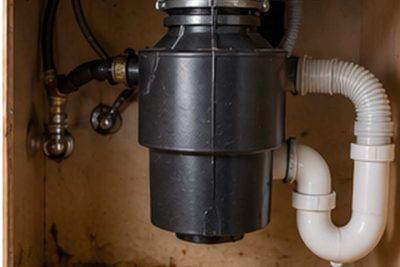
- If it hums but does not turn — the flywheel is jammed. Find the small hex key that came with the unit (often clipped underneath) and work it back and forth in the socket at the centre of the base until it moves freely.
- If it is silent — press the red reset button on the underside. If nothing, check the breaker. Then check the wall switch, which fails more often than disposals do.
If it hums again straight after freeing it, something is still lodged. Stop there rather than forcing it — repeatedly tripping a stalled motor is how a jam becomes a replacement.
Two situations where we will talk you out of one
1. You are on septic
This one is not negotiable for us. A septic system works by letting solids settle so bacteria can digest them. A disposal delivers a continuous stream of finely ground organic solids the tank was never sized for. The tank fills faster, pump-out intervals shorten, and solids carry toward the drain field.
A failed drain field is a five-figure repair. The disposal you did not fit costs nothing. That is the whole argument, and it applies across Hockessin, the rural edges of New Castle County and much of Cecil County.
2. You are on old cast iron drainage
Less absolute, but worth hearing. Pre-1970s Newark homes run cast iron drains that have scaled internally over decades — the bore is rough and already narrowed.
Ground food particles catch on that rough surface in a way they would not in smooth PVC. A disposal on a scaled cast iron line tends to produce exactly the recurring kitchen blockage described on our drain cleaning page.
If you want one anyway, that is a legitimate choice — but have the line inspected first, and know that hydro jetting may become a maintenance item rather than a one-off.
What actually kills them
Disposals rarely die of old age. They die of what goes into them.
- Grease and oil. Liquid going in, solid a few feet down the pipe.
- Coffee grounds and eggshells. Accumulate into a sediment that behaves like wet sand.
- Fibrous vegetables. Celery, artichoke, corn husks, onion skins — the strands wrap the flywheel.
- Starches. Pasta, rice, potato peel. They swell and form a paste that sets.
- Bones and fruit stones. The classic jam.
- Hot water while grinding. Counter-intuitive, but cold water keeps fats solid so they pass through instead of coating the pipe.
Repair or replace
Worth repairing: jams, a tripped reset, a failed wall switch, a leaking sink flange or a leaking discharge connection. All modest.
Worth replacing: a failed motor, a leak from the body of the unit itself, or persistent tripping under normal load. On a unit over about ten years old, replacement is usually the better value — the motor is most of the appliance.
A leak from the bottom of the housing is terminal, the same way a leaking water heater tank is. A leak from the sink flange on top is a reseal.
What an installation includes
- Old unit disconnected and removed, power isolated first.
- Sink flange reseated with fresh plumber's putty. Reusing the old seal is where most post-installation leaks come from.
- Mounting assembly fitted and the unit hung.
- Discharge connected, with the dishwasher inlet plug knocked out where a dishwasher drains through it — a step that is missed often enough to be worth naming, and which floods a dishwasher when it is.
- Electrical connection checked. Hard-wired or cord and plug, with a working switch.
- Run and tested under water, with every joint checked dry.
If your trap arm or drain is old cast iron and in poor condition, we will tell you before fitting a new unit onto it rather than after.
What it costs
- Jam clearing or reset diagnosis: often resolved on the phone at no charge
- Disposal installation or replacement: $300 to $650, including removal of the old unit
- Sink flange reseal or discharge repair: $150 to $350
If the real problem is the drain line rather than the disposal, we will say so — fitting a new appliance onto a failing line just moves the complaint. Full ranges on the pricing page.
Garbage Disposal Repair & Installation in Newark — common questions
A hum with no rotation means the motor has power but the flywheel is jammed. Switch it off at the wall before doing anything else — never put a hand in the chamber.
Most units ship with a small hex key that fits a socket in the centre of the underside. Work it back and forth to free the flywheel, then press the red reset button, also on the underside. That clears the majority of jams. If it hums again immediately, something is still lodged and it needs looking at rather than forcing.
Often not. Work through it in order: the reset button on the underside of the unit, then the breaker, then the switch. Wall switches fail more often than disposals do, and a tripped reset is the single most common cause of a unit that appears dead.
If all three check out and there is still nothing, the motor has likely failed. On a unit over about ten years old, replacement makes more sense than repair — the motor is most of the cost of the appliance.
We will not install one, and we will explain why rather than just declining. A septic tank works by letting solids settle and bacteria digest them. A disposal feeds it a continuous stream of finely ground organic solids it was never sized to handle, which fills the tank faster, shortens the interval between pump-outs, and pushes solids toward the drain field.
Replacing a failed drain field runs into five figures. The disposal you did not fit costs nothing. That trade is not close, and it applies across Hockessin, rural New Castle County and much of Cecil County.
Grease and oil, which solidify further down the line. Coffee grounds and eggshells, which accumulate into a sediment that behaves like wet sand. Fibrous vegetables — celery, artichoke, corn husks, onion skins — whose strands wrap the flywheel. Starchy foods like pasta, rice and potato peel, which expand and form a paste. Bones and fruit stones. And anything that is not food.
Run cold water, not hot: cold keeps fats solid so they pass through rather than coating the pipe on the way.
What to Expect
How a service call actually goes
No mystery and no vague promise to take a look. Here is the sequence from the moment you dial.
-
You call and describe the problem
A person picks up and asks practical questions — where the water is, whether it is still running, whether you have found the shutoff. If it is an emergency, we walk you through isolating it before we are anywhere near your street.
-
We give you an arrival window
A real window, not sometime today. You get a call before we head over. If the schedule slips, you hear it from us instead of wondering.
-
Diagnosis first, price second, work third
We find the actual cause before quoting. You get the price for the repair in front of you, and what it covers, before any work starts. If the honest answer is that a repair will not hold and you need a replacement, we say so and explain why.
-
We finish, test, and clean up
The repair gets tested under real conditions before we pack up — pressure restored, drains run, no weeping joints. Drop cloths down, debris out, and a plain-language explanation of what failed and what to watch for.
That sequence is the whole of our method, and how we work and price jobs explains the reasoning behind it — including the jobs we will talk you out of.