
Before anything else
If you can smell gas right now
- Leave the building. Do not operate any switch, appliance or phone inside.
- Do not look for the leak.
- From outside and well clear, call your gas utility's emergency line.
- Call us afterwards, once the utility has isolated it.
This is the only page on this site where the right first move is not to call a plumber. The utility attends gas emergencies at no charge and will make it safe faster than we can.
What gas work in Delaware actually requires
Gas is the most heavily regulated thing a residential plumber touches, and Delaware does not provide the homeowner latitude it allows elsewhere in plumbing.
- A licensed plumber. Not a handyman, not an appliance delivery crew, not you.
- A permit, issued through Newark Code Enforcement for city addresses.
- Inspection by a State of Delaware Plumbing Inspector, not a city inspector — the same split that catches people out on ordinary plumbing work.
- A pressure test before the line is concealed or commissioned.
Delaware allows a homeowner to do plumbing in a home they personally occupy. Gas is where we would tell you not to exercise that, and where an installer offering to skip the permit is telling you something important about how they work. More on the local permit process in our Newark permit guide.
What we get called for
New appliance runs
The bulk of the work. A line to a location that does not currently have one:
- Gas ranges and cooktops, often as part of a kitchen change from electric
- Gas dryers in laundry rooms plumbed only for electric
- Standby generators, which need a substantial run and careful sizing
- Outdoor grills, fire pits and patio heaters, ending a life of propane cylinders
- Garage and workshop heaters
- Gas fireplace inserts
Upsizing for tankless conversions
Worth its own heading, because it is the most commonly missed requirement in older Newark housing and the most common reason a tankless quote is wrong.
A conventional tank water heater might draw 35,000 to 40,000 BTU. A whole-house tankless unit can demand 150,000 to 199,000. The existing gas line and often the meter were sized for the old load, so the conversion frequently needs a larger run from the meter, and sometimes a larger meter.
An undersized line does not announce itself cleanly. It starves the unit, which underperforms on temperature, short-cycles, or throws faults that get blamed on the heater. If you have been quoted for a tankless conversion and gas upsizing was not discussed, ask why.
Before committing to the conversion at all, it is worth reading tank or tankless in an older Newark home. Gas capacity is only one of four constraints, and in some houses the four together change the answer.
Repairs, testing and leak location
Failed fittings, corroded exterior runs, valves that no longer seat, and lines disturbed by other trades. We pressure test to establish whether a system holds, and use combustible gas detection to locate where it does not.
Capping and removal
An abandoned line left open behind a wall is a genuine hazard. Removing a gas appliance means the line gets properly capped, not taped over.
Black iron or CSST
Two approved materials, and both are fine when installed correctly.
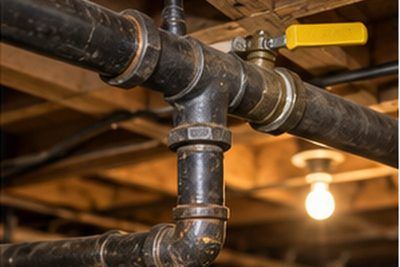
Black iron is rigid threaded pipe — the traditional material, robust, and what you will find in most older Newark basements. It takes longer to install because every change of direction is a threaded fitting.
CSST is flexible corrugated stainless steel. It routes through framing with far fewer joints and installs considerably faster. It must be electrically bonded to the building's grounding system, because a nearby lightning strike can otherwise arc through the thin tubing wall. That bonding is not optional and it is the thing most often skipped. We check it on any CSST we come across, including work that was not ours.
Carbon monoxide, which is the quieter risk
A gas leak announces itself by smell. Incomplete combustion does not — carbon monoxide is odourless, and the symptoms read as flu.
The causes sit at the appliance and the vent rather than in the gas line: blocked or disconnected flues, backdrafting, cracked heat exchangers, and appliances starved of combustion air in sealed utility rooms. When we work on gas appliances we check venting as a matter of course, which is also what the state inspection looks at on a water heater installation.
Have working CO alarms on every level of the house. They cost very little and they detect the thing you cannot.
What it costs
- New appliance run: $500 to $1,800, depending on distance from the meter, access and material.
- Gas leak location and repair: $200 to $800 for an accessible fault.
- Tankless gas upsizing: variable, and frequently the largest part of a conversion. Quoted after we have calculated the load.
- Permit and state inspection: included in the quote, never a surprise line.
Access drives the number, as it does everywhere. A run along an open basement ceiling is straightforward. The same run through a finished ceiling on a second floor is not. Full ranges on the pricing page.
Gas Line Installation & Repair in Newark — common questions
Leave the building first. Do not switch anything on or off, do not use a light switch, do not unplug anything, and do not use your phone inside — any of those can produce a spark. Open a door on the way out if it is on your path, but do not go looking for the source.
From outside and well clear of the building, call your gas utility's emergency line. They will attend and make it safe at no charge. Call us afterwards, once the utility has isolated it, for the repair.
This is the one situation on this website where the correct first action is not to call a plumber.
No. Delaware treats gas work as licensed plumbing work requiring a permit and inspection by a State of Delaware Plumbing Inspector, and unlike general plumbing there is no sensible homeowner route here.
The reason is not bureaucratic. Improper gas work causes explosions and carbon monoxide poisoning, and the failures are frequently invisible — an undersized line, a joint that passes a soap test but weeps under load, a vent that backdrafts. This is the category where the inspection genuinely earns its fee.
Because a tankless unit fires at a far higher input rate than the tank it replaces. A conventional 40 gallon heater might draw 35,000 to 40,000 BTU; a whole-house tankless can demand 150,000 to 199,000. The existing line was sized for the old load.
An undersized line does not fail obviously. It starves the unit, which then short-cycles, underperforms on temperature, or throws faults that get blamed on the heater. In older Newark homes this gas upsizing is frequently the single largest line item in a tankless conversion, and it is the requirement most often left out of a cheap quote. See our water heater page.
The pipework for a straightforward appliance run is usually a day. The schedule is set by the inspection rather than the labour: the line has to be pressure tested and seen by a State Plumbing Inspector before it is concealed or put into service.
Build that in rather than around it. A contractor proposing to close up or commission a gas line before inspection is telling you they are skipping the permit, and that is the version of this work you genuinely do not want.
CSST is corrugated stainless steel tubing — flexible gas line that installs faster than rigid black iron and can be routed through framing with fewer joints. It is an approved material and widely used in modern work.
The caveat is bonding. CSST must be electrically bonded to the building's grounding system, because a nearby lightning strike can otherwise arc through the thin tubing wall. Correctly installed and bonded it is fine; the failures that generated headlines were installations where the bonding was skipped. We check bonding on any CSST we encounter, including work we did not do.
What to Expect
How a service call actually goes
No mystery and no vague promise to take a look. Here is the sequence from the moment you dial.
-
You call and describe the problem
A person picks up and asks practical questions — where the water is, whether it is still running, whether you have found the shutoff. If it is an emergency, we walk you through isolating it before we are anywhere near your street.
-
We give you an arrival window
A real window, not sometime today. You get a call before we head over. If the schedule slips, you hear it from us instead of wondering.
-
Diagnosis first, price second, work third
We find the actual cause before quoting. You get the price for the repair in front of you, and what it covers, before any work starts. If the honest answer is that a repair will not hold and you need a replacement, we say so and explain why.
-
We finish, test, and clean up
The repair gets tested under real conditions before we pack up — pressure restored, drains run, no weeping joints. Drop cloths down, debris out, and a plain-language explanation of what failed and what to watch for.
That sequence is the whole of our method, and how we work and price jobs explains the reasoning behind it — including the jobs we will talk you out of.