
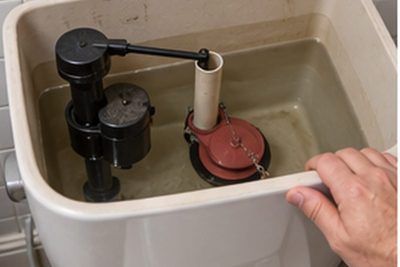
Three parts, and knowing which one
Almost every toilet fault is one of three components. Take the lid off the tank and you can see all of them.
| Symptom | Usual cause | Reasonable DIY? |
|---|---|---|
| Runs continuously or intermittently | Flapper not sealing | Yes — easiest job in plumbing |
| Tank refills on its own, unprompted | Flapper, or flush valve seat | Flapper yes, seat no |
| Takes a long time to fill | Fill valve, or a partly closed stop | Often |
| Hissing from the tank | Fill valve | Often |
| Weak or incomplete flush | Blocked rim jets, or low tank level | Sometimes |
| Water on the floor at the base | Wax seal or flange | No |
| Bowl rocks | Loose bolts or failed flange | No |
| Bubbling when another fixture drains | Venting or main line — not the toilet | No |
That last row matters. A toilet that gurgles when the washing machine drains is not a toilet problem at all — it is telling you about the main line. Replacing the toilet will not help.
The running toilet, and why it is worth caring about
A flapper that no longer seals lets water pass from tank to bowl continuously. Sometimes you hear it. Frequently you do not.
The food colouring test
A few drops in the tank, then leave it thirty minutes without flushing. Colour in the bowl means water is passing. A flapper costs a few dollars and is one of the genuinely reasonable DIY jobs in plumbing — shut the stop valve, flush to empty, unclip the old one, clip the new one on.
On a private well this deserves more attention, not less. There is no meter to flag the loss, so the first sign is a pump running more often than it should, and a continuously leaking toilet can meaningfully load a septic drain field over months.
The pre-war rough-in trap
Here is the one that catches people buying a replacement toilet for an older Newark or Wilmington bathroom.
The rough-in is the distance from the finished wall behind the toilet to the centre of the closet bolts. Modern standard is 12 inches, and that is what almost every toilet on a shop floor assumes.
Older American bathrooms also used 10 inch and 14 inch spacings. Plenty of pre-war housing in this area still has them. Buy a 12-inch toilet for a 10-inch rough-in and it simply will not sit against the wall.
Measure before you buy. Wall to bolt centres, not to the edge of the bowl. Ten and fourteen inch models exist but are a special order rather than a shelf item, which is worth knowing before you have removed the old one.
The flange, which is the part that actually matters
Everything visible about a toilet is porcelain and plastic. The part that determines whether the installation lasts is the closet flange bolted to the floor and connected to the drain.
Two failure modes, both common in older housing here:
- Corroded cast iron flanges. Mid-century Newark homes have cast iron drainage, and the flange corrodes like the rest of it. The bolt slots break away and the toilet loses its anchor.
- Flanges below the finished floor. Someone tiles over the original surface without raising the flange. The toilet now sits proud of it, the wax seal has to span a gap it was not designed for, and it eventually fails.
Both are fixable — repair rings for the first, extenders for the second — but both mean the toilet comes off, which is why a rocking toilet is worth dealing with before it becomes a subfloor job.
What an installation includes
- Old unit removed and disposed of. Water off, tank and bowl drained, lifted out.
- Flange inspected. Every time, not just when there is a symptom. This is the step that gets skipped on a cheap install.
- New wax seal or waxless gasket, correctly seated.
- New closet bolts, and a new flexible supply line — the old one is decades old and is a genuine flood risk left in place.
- New shutoff valve where the existing one is seized, which in an older house is most of the time.
- Levelled, secured and tested through several full flush cycles, watching the base.
What it costs
- Toilet repair (flapper, fill valve, flush valve): $150 to $400
- Toilet replacement: $350 to $800 including removal, new seal and supply line
- Flange repair or replacement: added where the flange has failed, quoted once we can see it
If the fault turns out to be venting or the main line rather than the toilet, we will tell you that instead of selling you a fixture that will not fix it. Full ranges on the pricing page.
Toilet Repair & Installation in Newark — common questions
Put a few drops of food colouring in the tank and leave it thirty minutes without flushing. If colour appears in the bowl, water is passing the flapper — the toilet is running even if you cannot hear it.
This matters more than it sounds. A silently leaking flapper can pass a surprising volume continuously, enough to show clearly on a water bill. On a private well it is worse, because there is no meter to warn you and the pump simply runs more. The fix is usually a flapper costing a few dollars.
Repair, in most cases. Flappers, fill valves and flush valves are inexpensive and a toilet that is otherwise sound will go on for decades.
Replace when the porcelain is cracked — that is terminal and no sealant fixes it. Replace when the bowl rocks because the flange beneath has corroded or broken, since you are pulling the toilet anyway. Replace when the model is old enough that parts are no longer made. And consider replacing a pre-1994 toilet on efficiency grounds: those use 3.5 gallons or more per flush against 1.28 for a modern unit.
Either the closet bolts have loosened, or the flange it sits on has failed. The flange is the fitting that anchors the toilet to the drain, and in older Newark homes it is often cast iron that has corroded, or it sits below the finished floor after someone tiled over the original surface.
Do not fix a rocking toilet with shims alone. The rocking breaks the wax seal, which then leaks slowly into the subfloor, and by the time it shows as a stain on a ceiling below you have a floor repair rather than a plumbing one. Have the flange looked at.
Generally not, for a straight like-for-like swap in the same location using existing connections. That falls on the repair side of the line rather than the alteration side.
You do need one for anything that moves or adds a fixture — relocating a toilet, adding a basement bathroom, or altering the drain and vent arrangement. Confirm your specific job with Newark Code Enforcement on (302) 366-7000.
What to Expect
How a service call actually goes
No mystery and no vague promise to take a look. Here is the sequence from the moment you dial.
-
You call and describe the problem
A person picks up and asks practical questions — where the water is, whether it is still running, whether you have found the shutoff. If it is an emergency, we walk you through isolating it before we are anywhere near your street.
-
We give you an arrival window
A real window, not sometime today. You get a call before we head over. If the schedule slips, you hear it from us instead of wondering.
-
Diagnosis first, price second, work third
We find the actual cause before quoting. You get the price for the repair in front of you, and what it covers, before any work starts. If the honest answer is that a repair will not hold and you need a replacement, we say so and explain why.
-
We finish, test, and clean up
The repair gets tested under real conditions before we pack up — pressure restored, drains run, no weeping joints. Drop cloths down, debris out, and a plain-language explanation of what failed and what to watch for.
That sequence is the whole of our method, and how we work and price jobs explains the reasoning behind it — including the jobs we will talk you out of.