
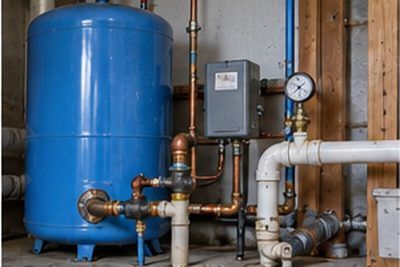
Two different water situations, minutes apart
This page covers the half of our service area that most Newark plumbing companies quietly ignore.
Inside the city, you are on City of Newark supply — treated, monitored, and published in an annual water quality report you can read. It is moderately hard, consistent, and largely undemanding. Head north and west toward Hockessin, Pike Creek, the rural edges of New Castle County and across into Cecil County, and private wells become common. Some properties add septic systems, which changes drain practice as well.
A well is not a slightly different version of city water. It is a small private utility that you own and operate, with no one checking it for you.
How a well system works, and where it fails
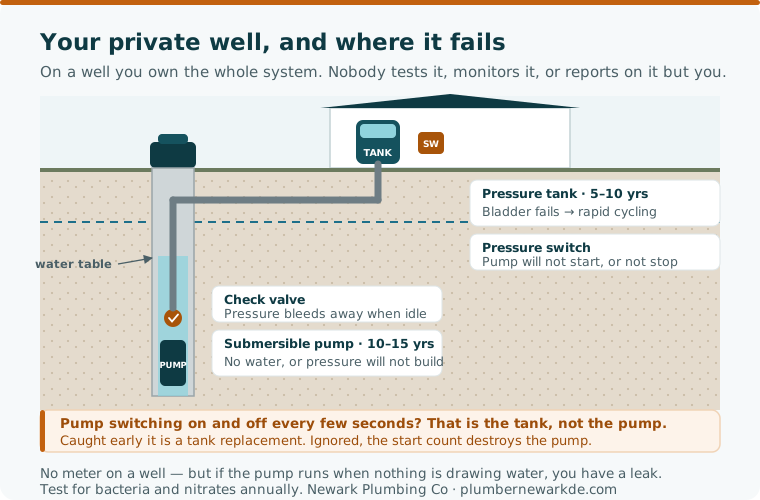
Four components do the work, and the symptoms point fairly reliably at which one is in trouble.
- The submersible pump, down the well, pushing water up. Lasts 10 to 15 years. Fails from age, sediment, or from being run dry.
- The pressure tank, holding a cushion of compressed air above the water so the pump does not start every time you open a tap. Lasts 5 to 10 years. When the bladder fails the tank waterlogs, and the pump begins switching on and off every few seconds.
- The pressure switch, telling the pump when to run. Cheap, and a common single point of failure.
- The check valve, stopping water draining back down the well between cycles.
Rapid cycling is the one to act on
A pump switching on and off every few seconds while a tap runs is almost always a waterlogged pressure tank, not a failing pump. Caught early it is a tank replacement. Ignored, the start count destroys the pump — and pulling a submersible pump is where the real money is. This is the clearest example in plumbing of a small repair preventing a large one.
Treatment: test first, and be sceptical
Water treatment is the most aggressively sold category in residential plumbing, and the sales model depends on you not having a test result. So get one.
On city supply: read the City of Newark water quality report. It is published annually and free. If someone has told you Newark water requires softening, check it against the actual figures before spending anything.
On a well: no one is testing it but you. Bacteria and nitrates annually; a broader panel covering hardness, iron, manganese, pH and sulphur every few years. Then treat what the test found:
| What you notice | Usual cause | Treatment |
|---|---|---|
| Scale on fixtures, poor lather | Hardness — calcium and magnesium | Ion exchange softener |
| Orange or brown staining | Iron | Oxidising filter |
| Black or dark staining | Manganese | Oxidising filter |
| Rotten egg smell | Hydrogen sulphide, or bacteria on the anode | Aeration or oxidising filter |
| Cloudy water, grit in aerators | Sediment | Sediment pre-filter |
| Positive bacteria test | Contamination | Shock chlorination, then UV |
| Fixtures corroding quickly | Low pH, acidic water | Neutralising filter |
Note that several of these need oxidation rather than softening. A softener fitted to an iron problem will foul and fail. Correct sequencing matters too: sediment filtration goes ahead of everything, and treatment stages have to be ordered so each one is not destroyed by what precedes it. This is the main reason poorly specified systems underperform.
If you are on septic as well
Many well-supplied properties around Hockessin, Pike Creek and rural Cecil County are also on septic, which changes what belongs in your drains.
- No garbage disposal. It loads the tank with solids it was never sized for. We will tell you this rather than fit one.
- No chemical drain cleaners. They kill the bacterial action the whole system depends on.
- Softener discharge needs thought. Backwash brine into a septic field is not ideal; the discharge route should be considered at installation rather than afterwards.
- Watch the water volume. A leaking toilet can quietly overload a drain field, and on a well you have no meter to warn you.
What we do
For pump and pressure problems: we test the system properly — pressure switch settings, tank pre-charge, draw-down volume, amperage at the pump — and identify which component has actually failed rather than replacing the most expensive one and hoping.
For treatment: we start from your test result. If the result says you need nothing, that is what we will tell you. If it says you need a specific filter rather than the softener you were quoted elsewhere, we will show you why in the numbers.
On city supply the equivalent document already exists and is free: the City of Newark publishes measured figures every year, including hardness. Our guide to reading Newark's annual water quality report covers where to find it, which columns matter, and how to convert mg/L into the grains per gallon a softener company will quote at you.
Typical ranges: well pump replacement $900 to $2,800, treatment installation $1,200 to $3,500. See full pricing. This work is concentrated around Hockessin, Pike Creek and Elkton and rural Cecil County. If your hot water is the specific complaint, the water heater page covers how well water affects tank life.
Water Treatment & Well Pump Service in Newark — common questions
If you are on City of Newark supply, probably not. Newark draws from the Newark Reservoir and treats to moderate hardness — not the range where scale usually justifies treatment. Softeners get sold hard in this area regardless, so it is worth checking before you buy one.
If you are on a private well toward Hockessin, Pike Creek or the rural edges of the county, the answer is genuinely unknown until tested. Well water varies property to property with no treatment and no reporting. Get a test first. We size from the result, and sometimes the result is that you do not need anything.
The usual signs are pressure that fluctuates while a tap runs, the pump cycling rapidly on and off, air spitting from taps, running out of water during normal use, or a sudden jump in the electricity bill because the pump is running far more than it should.
Rapid cycling is worth acting on quickly. It is most often a waterlogged pressure tank rather than the pump itself — a cheaper fix — but left alone it destroys the pump through sheer start count. Diagnosing it early frequently means replacing a tank instead of a pump.
A submersible well pump typically lasts 10 to 15 years, and a pressure tank 5 to 10. Sediment, frequent cycling and running the pump dry all shorten both considerably.
Because the pump sits at the bottom of the well, most of the cost of replacing it is the pulling and reinstallation rather than the pump. That makes it sensible to replace the tank, check valve and wiring at the same time if they are aged — the labour is already spent.
Yes, annually at minimum, and immediately if taste, smell or clarity changes. Private wells are not regulated or monitored by anyone — there is no utility checking on your behalf and no annual report arriving in the post. Whatever is in your water is your responsibility to discover.
Test for bacteria and nitrates every year, and run a broader panel including hardness, iron, manganese and pH every few years or whenever you are considering treatment. The Delaware Division of Public Health can point you to certified laboratories. Any treatment recommendation that arrives without a test result behind it is a sales pitch.
What to Expect
How a service call actually goes
No mystery and no vague promise to take a look. Here is the sequence from the moment you dial.
-
You call and describe the problem
A person picks up and asks practical questions — where the water is, whether it is still running, whether you have found the shutoff. If it is an emergency, we walk you through isolating it before we are anywhere near your street.
-
We give you an arrival window
A real window, not sometime today. You get a call before we head over. If the schedule slips, you hear it from us instead of wondering.
-
Diagnosis first, price second, work third
We find the actual cause before quoting. You get the price for the repair in front of you, and what it covers, before any work starts. If the honest answer is that a repair will not hold and you need a replacement, we say so and explain why.
-
We finish, test, and clean up
The repair gets tested under real conditions before we pack up — pressure restored, drains run, no weeping joints. Drop cloths down, debris out, and a plain-language explanation of what failed and what to watch for.
That sequence is the whole of our method, and how we work and price jobs explains the reasoning behind it — including the jobs we will talk you out of.