
A water bill that jumps with no change in habits is telling you something specific: water is leaving the system and not through a tap you turned on.
The good news is that finding it is a process of elimination that anyone can run, and an hour is usually enough to get from somewhere in the house to that fixture.
Work through this in order. Each step either finds it or rules out a category.
Step 1 — Confirm it is a leak at all (10 minutes)
Before hunting, establish there is something to hunt.
- Turn off every tap, appliance and ice maker. Nothing running anywhere.
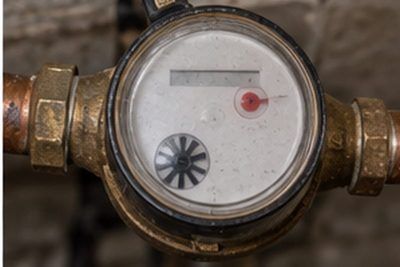
- Find your water meter. In most Newark homes it is in the basement near where the service line enters; some properties have it in an outside pit.
- Note the reading, or watch the low-flow indicator — the small dial or triangle that spins on tiny flows.
- Wait two hours with nothing drawing water.
- Read it again.
Movement means water is leaving the system. No movement over two hours means your bill increase came from somewhere else — a rate change, an estimated reading, a longer billing period, or genuinely higher use such as house guests, a new appliance, or filling a pool.
If the low-flow indicator is spinning visibly, you have a substantial leak and can skip straight to step 3.
Step 2 — Rule out the toilets (10 minutes)
Do this before anything else, because it is the most common answer by a wide margin.
A flapper that no longer seals passes water from tank to bowl continuously. It drains straight down, so there is frequently no sound and nothing to see.
The food colouring test, on every toilet in the house:
- A few drops of food colouring into the tank, not the bowl.
- Wait thirty minutes. Do not flush.
- Look in the bowl.
Colour in the bowl means that flapper is passing. A replacement costs a few dollars and is genuinely one of the reasonable DIY jobs — see toilet repair.
In a shared house this is especially worth checking, because nobody reports a silent toilet when nobody is paying the water bill.
Step 3 — Inside or outside? (10 minutes)
This is the step that halves the search.
Most properties have a shutoff valve where the supply enters the building, separate from the street-side curb stop.
- Close that valve.
- Watch the meter for fifteen minutes.
| Meter behaviour | What it means |
|---|---|
| Stops | Leak is inside the building. Go to step 4. |
| Still moving | Leak is between the meter and the valve — the buried service line or an outdoor connection. Step 5. |
If you cannot find or turn that valve, that is worth fixing on its own account. A main shutoff that will not close is its own emergency, discovered at the worst possible moment.
Step 4 — Narrow it down inside (20 minutes)
Work in this order. It runs from most likely to least.
Water heater. Look underneath and around the base for pooling or staining. Check the temperature and pressure relief valve and its discharge pipe — a T&P valve weeping into a floor drain loses water invisibly. Rusty staining at the base of the tank suggests it is perforating, which is terminal.
Under every sink. Feel around the trap, the supply connectors and the shutoff valves. Look for staining on the cabinet base, which indicates a leak that has been going a while.
Behind toilets. The floor around the base, and the supply connector.
The washing machine. Supply connectors, especially plastic ones, and the drain hose connection. Braided stainless is what you want here — plastic connectors cause a startling share of household floods.
Showers and baths. Run each for several minutes and check the ceiling below if there is one. Look at the grout and the seal around the base.
Anything outside a wall on the floor below. Water travels along joists and surfaces a long way from its source, so a ceiling stain is a starting point rather than a location.
Any whole-house filter or water softener. Check the bypass and connections.
If you find nothing but the meter is still moving with the house isolated from outside, the leak is concealed — inside a wall, under a slab, or beneath a floor. That is where professional leak detection earns its money: acoustic and thermal location means opening one section of wall rather than five.
Step 5 — Outside (10 minutes)
If the meter kept moving with the building isolated, look at:
The lawn between the street and the house. An unusually green, soft or lush strip following the line of the pipe, especially noticeable in dry weather. On a slope, the wet patch may appear downhill of the actual leak.
Irrigation systems. A stuck valve or a cracked head runs continuously without anyone noticing. If you have irrigation, isolate it at its own valve and watch the meter again.
Outside taps. Check each hose bibb, and whether a hose is left connected to something that is filling.
Pools, hot tubs, ponds. Anything with a fill line.
A buried service line leak is the most likely finding here, particularly in older Newark and Wilmington housing where the line may be aged galvanized steel.
If you are on a well
No meter, so the sequence above does not start the same way — but you have a good substitute.
With everything off, listen for the pump. A pressure system only starts when pressure drops, and pressure only drops when water leaves. If the pump cycles on with nothing running, something is leaking.
Time the interval. Every few minutes suggests a substantial loss; every couple of hours a slow one. Then work through steps 2, 4 and 5 exactly as above.
One distinction worth making: rapid cycling while a tap is running is a different fault entirely. That is usually a waterlogged pressure tank, and it is destroying your pump while you watch — see well pumps and water treatment.
Well owners have the harder version of this problem, because there is no bill to warn you. A leak on a well shows up as a pump running more, an electricity bill creeping up, and eventually a failed pump.
What tends to be the answer
In rough order of how often each turns out to be the cause:
| Cause | Notes |
|---|---|
| Running toilet | The most common by a distance. Silent and continuous. |
| Dripping tap or worn cartridge | Visible, and adds up faster than people expect |
| Water heater T&P valve weeping | Discharges to a drain, so invisible |
| Irrigation valve stuck or cracked head | Seasonal, and often runs for weeks |
| Supply connector at a toilet or washing machine | Can be a slow weep or a sudden flood |
| Buried service line | Meter keeps moving with the house isolated |
| Slab or in-wall leak | Needs acoustic or thermal location |
Ask about a bill adjustment
Many suppliers operate some form of leak adjustment — typically once, and typically requiring evidence the leak was found and fixed. Terms vary, so ask yours directly.
Keep the plumber's invoice describing the fault and the repair. That is the documentation these schemes normally want, and it is far easier to keep at the time than to obtain months afterwards.
In short
Confirm it with the meter test — everything off, two hours, read again. Then rule out the toilets with food colouring, because that is the answer more often than anything else.
Close the valve where the supply enters the building and watch the meter again: stops means inside, keeps moving means the buried line. Then work through the house in order, or the lawn if it is outside.
On a well, substitute the pump for the meter — if it cycles with nothing running, water is going somewhere.
An hour usually gets you from somewhere to there. If it does not, the leak is concealed, and that is the point at which locating it properly saves more than it costs.
Related questions
Enough to be the single most common explanation for a bill that jumps with no change in habits. A flapper that no longer seals passes water continuously, and because it drains straight into the bowl there is often no sound and nothing visible.
It is also the cheapest thing on this list to rule out. Put a few drops of food colouring in the tank, wait thirty minutes without flushing, and look in the bowl. Colour means the flapper is passing. A replacement costs a few dollars.
That combination points at a leak you cannot see from inside: an underground supply line, a slab leak, or an irrigation system. Look outside for an unusually green or soft strip of lawn running from the street toward the house, particularly during dry weather.
The isolation test narrows it. If your property has a shutoff where the supply enters the building, close it and watch the meter. Still moving with the house isolated means the leak is between the meter and that valve — the buried service line. Stopped means it is inside.
You have no meter, but you have something nearly as good. With every tap and appliance off, listen for the pump. If it cycles on when nothing is drawing water, something is leaking. A pressure system only starts when pressure falls, and pressure only falls when water leaves.
Note the interval between cycles — every few minutes suggests a substantial loss, every couple of hours a slow one. Rapid cycling while a tap runs is a different fault: that is usually a waterlogged pressure tank, covered on our well systems page.
Many suppliers operate some form of leak adjustment, typically once and typically requiring proof that the leak was found and repaired. Terms vary considerably, so ask yours directly rather than assuming either way.
Keep the plumber's invoice describing the fault and the repair. That is the documentation these schemes usually ask for, and it is far easier to hold onto at the time than to obtain months later.