
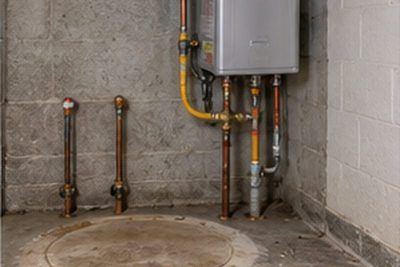
Every comparison of tank against tankless says the same things, and they are all true: tankless gives endless hot water, takes less space, uses less energy standing idle, and lasts longer.
None of that decides anything, because it is equally true in a 1920s house on Delaware Avenue and a 2015 townhouse in Bear, and those two houses should reach opposite conclusions.
What actually decides it is infrastructure. Here are the four things that settle it in an older Newark home, in the order they tend to matter.
1. Winter inlet temperature — the number nobody quotes you
This is the one that catches people, and it is genuinely local.
A tankless unit does not have a capacity. It has a flow rate at a given temperature rise, and those two trade against each other continuously.
Rise = the temperature you want − the temperature coming in
If you want 120°F water and the cold supply arrives at 70°F, that is a 50-degree rise. If it arrives at 45°F, that is a 75-degree rise — half as much again, from the same unit.
Manufacturers quote headline GPM figures at a modest rise, because that is the flattering number. In January in northern Delaware you are not operating at a modest rise. Incoming water here commonly sits in the 40s to low 50s through mid-winter, against the 60s and 70s in late summer. The same unit that comfortably ran two showers in August will not in February.
Measure it yourself, in winter
Run the cold tap for two minutes in the coldest week of the year and hold a kitchen thermometer in the stream. That single number — subtracted from 120 — is the rise your unit has to achieve, and it is the only honest basis for sizing one. A quote produced without it is a guess.
Then add up what you actually run at once:
| Fixture | Typical flow |
|---|---|
| Shower | 1.5–2.5 gpm |
| Kitchen sink | 1.5–2.2 gpm |
| Bathroom basin | 1.0–1.5 gpm |
| Dishwasher | around 1 gpm |
| Washing machine | around 2 gpm |
Two showers at once in a family house is 3 to 5 gpm at a 70-degree-plus rise. That is a large unit, not a mid-range one, and the difference shows in both the appliance price and the gas load behind it.
A tank does not care about any of this. It cares only about total volume, which is why a tank in a cold climate is a genuinely reasonable engineering answer rather than an outdated one.
2. Gas capacity
A conventional 40-gallon heater might draw 35,000 to 40,000 BTU. A whole-house tankless can demand 150,000 to 199,000.
The gas line in your house — and sometimes the meter — was sized for the first number.
This is covered in full on the gas line services page, including why an undersized line does not fail obviously but instead starves the unit into short-cycling and temperature faults that get blamed on the heater.
The point for the decision is simpler: in older Newark housing, the gas upsizing is frequently the largest single line item in the conversion, and it buys you no hot water at all. It is the cost of making the appliance possible.
Which means the honest question is not "is tankless better than a tank?" It is "is tankless better than a tank, plus a gas run from the meter, plus venting, plus a condensate drain?" That is a different question and it gets a different answer in a lot of houses.
3. Venting, and what the old chimney was doing
A tankless unit does not vent like a tank. Condensing models vent through PVC or polypropylene, usually horizontally through a side wall; non-condensing models need stainless steel rated for the temperature. The existing flue is generally not reusable.
In an older Newark home there is a second-order effect worth knowing about. Many of these houses have a masonry chimney serving both the furnace and the water heater. Take the water heater off that chimney and you have changed what the chimney is doing — the remaining appliance now vents alone into a flue sized for two.
That is not automatically a problem, but it is automatically a question, and it has to be assessed rather than assumed. An installer who removes an appliance from a shared flue without looking at what is left is not finishing the job.
4. Electrical service
Two separate issues here.
Gas tankless units need power. Modern units have electronic ignition, controls and a fan, so a unit that heats with gas still needs an outlet. In a basement where the old tank had no electrical connection at all, that is a circuit to run.
Electric whole-house tankless is usually a non-starter in older housing. These units want somewhere in the region of 75 to 150 amps of dedicated capacity. A great many older Newark homes have a 100 or 150 amp service in total, so the appliance is asking for most or all of the house. The answer is a service upgrade, which is not the cheap alternative to gas work that people hope it is.
Electric tankless does make sense at point of use — a remote bathroom, a garage sink, an addition at the far end of the house — where the run from the main heater is so long that you waste more water waiting than you would spend heating.
The two that are easy to miss
Condensate. A condensing tankless produces acidic condensate, which needs a drain and usually a neutraliser cartridge. If there is no drain near the unit you also need a condensate pump. Small item; frequently absent from a cheap quote.
Isolation valves. A tankless heat exchanger needs periodic descaling, and that is done by circulating solution through purpose-made service valves. Omitting them saves perhaps a hundred dollars at install and makes every future service call harder. Their absence is one of the fastest ways to tell a considered installation from a rushed one.
Water quality changes the answer
On City of Newark supply at moderate hardness, a tankless heat exchanger is in a reasonable environment. Annual servicing is sensible; it is not a crisis if you are late.
On a private well around Hockessin or Pike Creek, untreated water can be considerably harder, and a tankless heat exchanger is much less forgiving of scale than a tank is. A tank quietly accumulates sediment on the floor and carries on working badly; a tankless narrows its exchanger and starts throwing faults.
If you are on a well and considering tankless, treat the water first or plan on a strict descaling regime. Test before you decide — see well pumps and water treatment and how to read a water quality report for what the figures mean.
So which one
| A tank is probably right when | Tankless is probably right when |
|---|---|
| The existing one failed and you need hot water this week | You are already opening walls or doing a renovation |
| The gas line would need substantial upsizing | The gas supply is already adequate |
| Budget is the binding constraint | You genuinely run out of hot water with a tank |
| Demand is peaky rather than sustained | The floor space is worth real money to you |
| You are selling within a few years | You intend to stay long enough for 15–20 years of life to matter |
| You are on untreated well water | You are on treated or moderate-hardness supply |
| The service is 100 amps and the only option is electric | Two bathrooms genuinely compete at the same time |
The pattern in that table is worth stating directly: tankless rewards planning and punishes emergencies.
If your tank fails on a Friday in February, the tankless conversion is the wrong answer that week — not because the technology is worse, but because you will be paying emergency rates for infrastructure work while taking cold showers. Replace like for like, and plan the conversion for a renovation, if you still want it then.
If you are remodelling a basement, moving a bathroom, or already having gas work done, the marginal cost of tankless drops sharply and the calculation changes.
On payback periods
Be sceptical of any quoted payback figure, including a confident one.
The honest version is arithmetic you can do yourself: take the annual energy saving you are being promised, and divide the total installed difference — appliance, gas upsizing, venting, condensate, electrical — by it. Not the appliance difference. The total.
Do that with your own numbers rather than a national average, because the infrastructure half of the cost is entirely specific to your house, and that is the half that decides it.
In short
Four things decide tank against tankless in an older Newark home, and none of them is the technology.
Winter inlet temperature, because a tankless is rated at a temperature rise and the rise here is much larger in February than the box assumes — measure your cold tap in the coldest week and size from that. Gas capacity, because a tankless fires at three to five times a tank's input and the upsizing is often the biggest line in the quote. Venting, because the old flue is generally unusable and removing an appliance from a shared chimney changes what is left. And electrical service, which rules out whole-house electric tankless in most older housing here.
Tankless rewards planning and punishes emergencies. If the tank died this morning, replace it and revisit the question when you are not showering in cold water. See water heater repair and replacement for what each route actually involves.
Related questions
Endless in duration, yes — it heats on demand rather than storing, so it will not run out the way a tank does. But it is limited in rate, and that is the constraint people meet in practice.
A tankless unit can only raise water by so many degrees at so many gallons per minute. Exceed that flow and the temperature drops. So a tank runs out after twenty minutes and a tankless never does, but the tankless may not run two showers and a dishwasher at once in January. Neither is better; they fail differently.
Because the rating is quoted at a temperature rise, and the rise is bigger in winter.
A unit advertised at, say, 6 GPM is quoting that at a modest rise — often around 35 to 45°F. In mid-winter here the water entering your house is far colder than in August, so getting it to 120°F takes a much larger rise, and the same unit delivers considerably fewer gallons per minute. Size on your coldest month, not on the box. Run the cold tap in February, hold a thermometer in the stream, and use that number.
Rarely as a straight swap. Four things usually change: the gas supply needs upsizing because a tankless fires at three to five times the input rate of a tank; the venting is different and the old flue generally cannot be reused; a condensing unit needs a condensate drain and often a neutraliser; and the unit needs power.
None of that is difficult work, but it is work, and it is why a tankless conversion quote that looks like a tank replacement quote is missing something. See gas line services for the upsizing part.
They move the problem rather than removing it. A whole-house electric tankless typically wants somewhere between 75 and 150 amps of dedicated capacity — which in a house with a 100 or 150 amp service is most of what you have.
That usually means a service upgrade, which is not cheaper than gas upsizing. Electric tankless makes real sense at point of use: a remote bathroom, a garage sink, a workshop, an addition a long way from the heater. As a whole-house replacement in older Newark housing it seldom works out.