
Low water pressure is one of the most common complaints we get, and one of the most variably diagnosed. The cause might be a clogged aerator you can fix yourself in five minutes, or it might be sixty years of corrosion inside your walls.
Work through these in order. Each step either narrows it down or rules out an expensive possibility.
Step 1: Is it one fixture or the whole house?
This single question eliminates most of the possibilities immediately.
One fixture only — the problem is at that fixture. Almost always an aerator clogged with mineral deposit, or a cartridge that needs replacing. Unscrew the aerator from the tap spout, rinse the screen, refit. On a shower, soak the head in descaler. This is genuinely a five-minute job and it resolves a surprising proportion of pressure complaints.
Several fixtures or the whole house — continue.
Step 2: Measure it
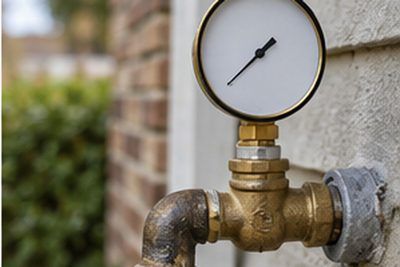
Stop guessing and get a number. A pressure gauge that screws onto an outdoor tap costs very little at any hardware store, and it converts a subjective complaint into data.
Attach it to an outside bibb or a laundry tap, open fully with nothing else running, and read it.
| Reading | What it means |
|---|---|
| Below 40 psi | Genuinely low. Continue diagnosing. |
| 40–60 psi | Normal. If it feels weak, the problem is flow rather than pressure — see step 5. |
| 60–80 psi | High side of normal. |
| Above 80 psi | Too high. Different problem, and worth fixing. |
High pressure is worth acting on even though it feels good. Above 80 psi shortens the life of every fixture, appliance, supply connector and valve in the house, and manufacturer warranties commonly exclude damage caused by it. That usually points at a pressure-reducing valve needing adjustment or replacement.
Step 3: Did it change suddenly or gradually?
The timeline points at different causes.
Suddenly — something discrete happened. A failed pressure-reducing valve, a partially closed valve after recent work, a water main issue on the street, or a significant leak. Ask your neighbours; if the whole street is affected, call the water supplier before calling a plumber.
Gradually over years — something is building up. Corrosion narrowing the pipe, sediment accumulating, or a filter cartridge loading. This is the more common pattern in older Newark housing and it is the one people adapt to without noticing.
Always been this way — likely a design characteristic. Undersized supply line for the house, elevation, or a plumbing system that was never upgraded after an addition.
Step 4: Check the easy things
Before assuming the worst, rule out the cheap causes.
- Whole-house filter cartridge. If you have one and it is overdue, change it. A loaded cartridge restricts flow measurably.
- Main shutoff not fully open. Sounds obvious. It happens routinely after repairs, and a valve that is three-quarters open looks open.
- Pressure-reducing valve. If your house has one where the service line enters, it has a service life of roughly fifteen to twenty years. Symptoms include pressure that wanders, creeps up over months, or produces a bang when a washing machine valve shuts. Common in the 1990s and 2000s subdivisions around Bear, Glasgow and Middletown, many of which are now at that age.
- Water heater shutoff partially closed. If only hot is affected.
- Water softener in bypass or fouled. If you have one, check it is functioning.
Step 5: The test that identifies corroded pipe
This is the important one for older Newark housing, and it takes thirty seconds.
Run one tap. Then open a second one and watch the first.
If the first tap drops off sharply the moment the second opens, you have a restriction inside your plumbing. A system with its full bore intact supplies two fixtures without drama. One that collapses is telling you the usable diameter is already marginal.
That is the signature of corroded galvanized steel supply pipe, and in Newark's pre-1960s core it is the most likely explanation for gradual pressure loss.
Confirming it
Go to the basement, find an exposed supply pipe, and hold a fridge magnet against it. It grips galvanized steel and ignores copper and PEX.
Magnet grips, house predates 1960, pressure collapses on a second tap — you are on original steel that is past its 40 to 70 year service life. Rust has been growing inward since installation and the bore is a fraction of what it was.
Watch for the supporting symptoms too: hot side worse than cold (heat accelerates corrosion), and rusty water on first draw after the house sits unused.
This is covered in depth in galvanized pipe in older Newark homes, and the fix is whole-home repiping.
The catch
Many Newark homes were partially repiped over the years. Copper near the water heater does not mean the house is copper — the original steel usually survives inside the walls. Check more than one location, and check runs that disappear into walls rather than the accessible ones at eye level.
Step 6: If you are on a well
No public main, different diagnosis. Around Hockessin, Pike Creek and the rural county, look at:
- Pressure switch settings. These set the cut-in and cut-out points and can be adjusted, within the pump's capability.
- Waterlogged pressure tank. If the pump switches on and off every few seconds while a tap runs, the tank bladder has failed. Act quickly — the tank is cheap, and while it is failing the pump is accumulating start cycles that will destroy it.
- Failing pump. Pressure that will not build, or drops during sustained use.
- Clogged sediment filtration ahead of the house.
See well pumps and water treatment.
Step 7: Elevation, which is not fixable
Sometimes the answer is physics rather than a fault.
Water loses roughly 0.43 psi for every foot it climbs. In a two-storey house that is a real and normal difference between the basement tap and the upstairs shower. On a hillside property where the house itself sits well above the supply main, that loss stacks on a lower starting point.
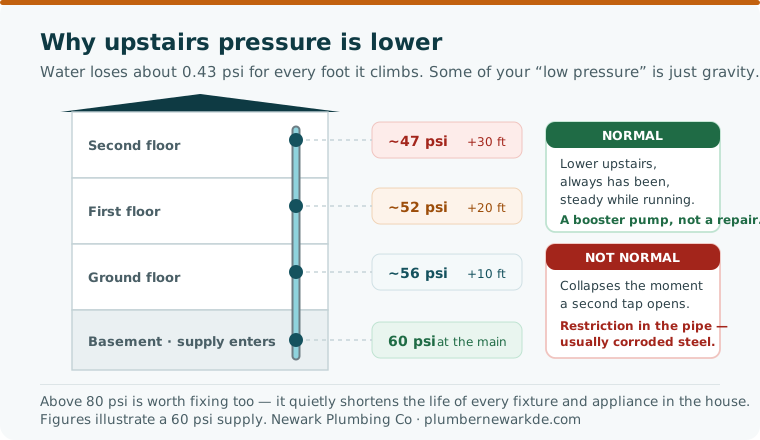
This is routine around Pike Creek and the Piedmont ground north of Newark. If pressure has always been lower upstairs and nothing has changed, no plumbing repair will alter it — a booster pump is the honest answer, and we would rather say so than sell you a repipe that will not change the number.
Step 8: Consider whether it is actually a leak
A significant leak somewhere in the system shows up as reduced pressure, and it is worth ruling out because it is doing damage while you investigate.
The meter test. Turn off every fixture and appliance. Note your water meter reading or watch the low-flow indicator. Wait two hours with nothing running. Read again. Movement means water is leaving the system somewhere.
On a well there is no meter, but the pump substitutes: if it runs when nothing is drawing water, something is leaking. Either way, see leak detection.
Putting it together
| What you observe | Most likely cause |
|---|---|
| One fixture only | Aerator or cartridge |
| Sudden, whole house | PRV failure, valve position, or street-side issue |
| Gradual over years, pre-1960 house | Corroded galvanized supply |
| Collapses when a second tap opens | Restriction in the supply pipe |
| Hot side only | Water heater sediment, or corroded hot runs |
| Upstairs only, always been so | Elevation |
| Pump short cycling (well) | Waterlogged pressure tank |
| Meter moves with everything off | Leak |
The short version
Start narrow and work outward. One fixture means clean the aerator. Whole house means measure the pressure, then check the timeline, then test whether it collapses when a second tap opens.
That last test is the one that matters in older Newark housing. If pressure falls away the moment a second fixture runs, and a magnet grips your supply pipe, the answer is inside your walls — and no amount of adjusting valves will change it.
Related questions
Most residential plumbing is designed for roughly 40 to 60 psi, and anything in that band is comfortable. Below about 40 psi fixtures start feeling weak, particularly showers with pressure-balancing valves.
Above 80 psi is the range worth acting on. High pressure does not feel like a problem — it feels great — but it shortens the life of every fixture, appliance, valve and connector in the house, and most manufacturer warranties exclude damage caused by it. A pressure gauge on an outdoor tap costs very little and settles the question in a minute.
If cold is fine and hot is weak, the restriction is on the hot side specifically. Three usual causes: sediment in the water heater reducing flow, a partially closed or failing shutoff valve at the heater, or corrosion in the hot supply runs.
That last one is the common answer in older Newark housing. Heat accelerates corrosion, so in a house on original galvanized steel the hot runs degrade faster than the cold. Hot-side-only pressure loss in a pre-1960 home is a fairly reliable indicator of where that system has got to.
Yes, and it is one of the more commonly overlooked causes. Whole-house filters and sediment cartridges restrict flow as they load up, and a cartridge well past its replacement interval can noticeably reduce pressure throughout the house.
It is worth checking early because it is cheap and quick. If pressure has declined gradually over months and you have a whole-house filter, change the cartridge before investigating anything more expensive.