
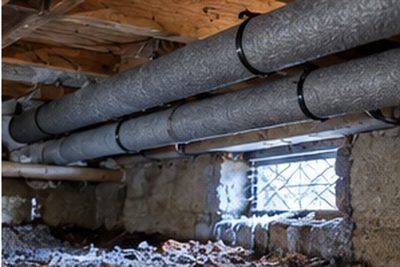
Most advice about frozen pipes is written for a climate Newark does not have. It assumes weeks of hard freeze, deeply frozen ground, and pipes that stay frozen until spring. Northern Delaware works differently, and the difference changes what you should actually protect.
The buried service line is not your problem
Start by ruling out the thing most people worry about first.
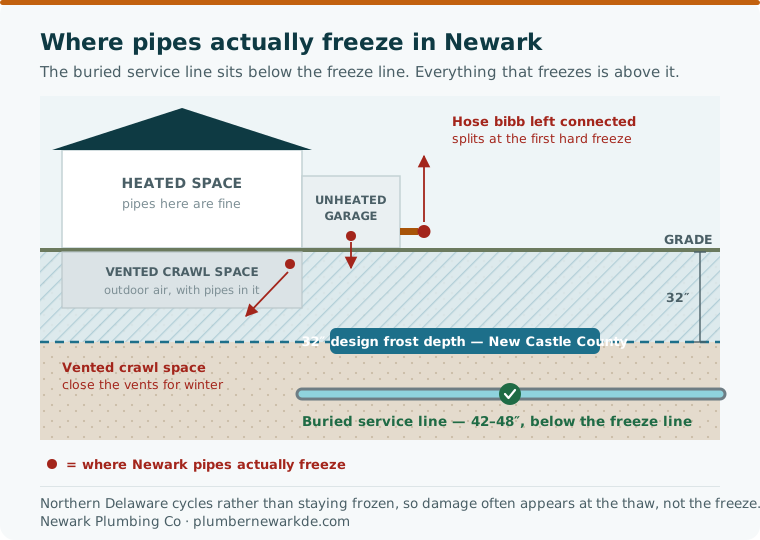
New Castle County building code sets a design frost depth of 32 inches, and buried water service lines are installed below it with margin — commonly in the 42 to 48 inch range. The freeze line does not reach them in a normal winter.
So when a pipe freezes at a Newark address, it is almost never the line coming in from the street. It is a run inside the building envelope that is not really inside it:
- Crawl spaces with vents that were never closed for winter
- Unheated garage walls with plumbing on the far side
- Plumbing on the exterior wall of an older house with little or no insulation behind the plaster
- Attic runs above the insulation line rather than below it
- Hose bibbs that were not shut off and drained
- Kitchen sinks on an outside wall, where the cabinet blocks room heat from reaching the pipes
Every one of those is fixable before winter, and most cost very little.
Why freeze-thaw is worse than steady cold
Here is the part specific to this region.
A pipe in Minnesota freezes in December and stays frozen. That is a single stress event, repeated once. Northern Delaware cycles — cold nights, milder days, another cold snap a week later. Over a winter a vulnerable pipe can freeze and thaw a dozen times or more.
Each cycle expands the water, stresses the joint, and relaxes it again. Materials tolerate one cycle easily. It is the fifteenth that opens a solder joint or splits a fitting. This is why a pipe that has been fine for twenty winters suddenly fails: nothing changed except the accumulated count.
The consequence people miss
Ice does not leak. When water freezes and splits a pipe, the same ice is plugging it. Nothing appears. The house seems fine.
Then it thaws, and the split opens onto whatever is below it.
This is why the busiest emergency period in a Newark winter is not the cold snap — it is the days after. If you had a frozen pipe this winter and it seemed to recover on its own, assume there is damage waiting for the thaw and check it.
What to do before the first hard freeze
These are in order of how much trouble they prevent per minute spent.
1. Deal with the hose bibbs
The single most common winter failure in this area, and the easiest to prevent.
- Find the shutoff valve inside the house for each outdoor tap, usually just inside the wall it passes through.
- Close it.
- Go outside and open the outdoor tap, leaving it open all winter so any remaining water can expand harmlessly.
- Disconnect every hose. A connected hose traps water against the valve and guarantees the split.
Frost-free bibbs still need the hose disconnected. A hose defeats the frost-free design entirely by preventing the drain-down the mechanism relies on.
2. Close crawl space vents and check the door
Foundation vents exist for summer moisture control. Left open in winter they turn a crawl space into outdoor air with plumbing in it. Close them, and check that the access door actually seals — a gap channels wind directly at your pipes, which does more damage than the temperature alone.
3. Insulate the runs that are genuinely exposed
Foam pipe sleeve costs very little and installs by hand. Prioritise:
- Anything in a crawl space, garage or attic
- Runs on exterior walls
- The first few feet in either direction from where a pipe passes through an unheated space
Insulation slows heat loss; it does not add heat. On a genuinely exposed run in a hard freeze, insulation alone may not be enough — that is what heat cable is for, and it needs a proper thermostat and a GFCI outlet.
4. Find your main shutoff, and confirm it turns
Do this now, in daylight, while nothing is wrong.
In most Newark homes with a basement, the main valve is on the wall facing the street, near where the service line enters and close to the meter. In slab-built homes and newer townhomes it is more often in a utility closet, the garage, or near the water heater.
Then actually turn it. Valves that have not moved in twenty years seize, and discovering that during an emergency is its own disaster. If it will not close, that is worth fixing on an ordinary weekday.
During a cold snap
- Open cabinet doors under sinks on exterior walls so room heat reaches the pipes.
- Let vulnerable taps drip. A slow drip relieves pressure; it does not need to be a stream.
- Keep the heat on if you travel. No lower than about 55°F. A house left cold to save on heating is a very expensive saving.
- If you leave for an extended period in winter, consider shutting the water off at the main and draining the system.
If a pipe has already frozen
You will usually notice as no water, or a trickle, from one fixture while the rest of the house is fine. That localisation is the clue — it tells you roughly which run is affected.
- Open the affected tap. Melting water needs an escape route, and flow returning tells you it worked.
- Apply gentle heat from the tap end backwards. Hairdryer, heat gun on low, or hot towels. Working from the tap end matters: heating the middle first traps meltwater between two ice plugs and raises pressure in exactly the wrong place.
- Never use an open flame. Not a blowtorch, not a propane heater. Fire risk in a wall cavity, and rapid uneven heating can burst the pipe.
- Watch for water as it thaws. If the pipe split while frozen, thawing is when you find out. Know where your shutoff is before you start.
Call if you cannot locate the frozen section, if it is inside a wall you cannot reach, or if water appears as it thaws. That last one is an emergency — shut the water off first, then call.
The older-house factor
If your house predates 1960 and still runs original galvanized steel supply, freeze risk sits on top of a pipe that is already compromised. Decades of internal corrosion have thinned the wall, and thinned pipe splits at stresses that sound pipe would shrug off.
A house in that condition that has already produced pinhole leaks is telling you something, and winter will find the weakest point. Our page on whole-home repiping covers what that decision looks like.
The short version
Buried lines are fine — they sit below the 32-inch frost depth. What freezes in Newark is exposed: crawl spaces, garage walls, attics, and hose bibbs left connected. Drain the bibbs, close the vents, insulate what is exposed, know where your shutoff is and confirm it turns.
And if something froze and then seemed to fix itself, do not relax. Check it before the thaw does it for you.
Related questions
There is no single number, because what matters is the temperature at the pipe rather than the temperature outside. The commonly cited threshold is around 20°F (-7°C) sustained, but a pipe in a sealed, insulated wall can survive far colder outside air, while a pipe in a draughty crawl space can freeze at an outdoor reading well above that.
Wind matters more than most people expect. Moving air strips heat from an exposed pipe far faster than still air at the same temperature, which is why the pipe that froze was usually the one near a vent, a gap in the sheathing, or an ill-fitting crawl space door.
On genuinely cold nights, yes — for the taps served by vulnerable runs. Moving water freezes more slowly, and more importantly a slightly open tap gives expanding ice somewhere to push, which relieves the pressure that actually splits pipes.
A slow steady drip is enough; a running stream is waste. Choose the tap furthest from where the water enters the house, and if you have vulnerable pipes on both hot and cold, drip both.
Open the tap that pipe serves first, so melting water has an escape and you can see progress. Then apply gentle heat starting at the tap end and working back toward the frozen section — a hairdryer, a heat gun on low, or towels soaked in hot water. Working from the tap end matters, because thawing the middle first traps meltwater between two plugs of ice.
Never use an open flame, a blowtorch or a propane heater. Beyond the fire risk in a wall cavity, rapid uneven heating can burst the pipe outright. If you cannot reach the frozen section, or you are not certain where it is, stop and call.